

Fun fact about the well-known maxim (and perhaps even topical for this combo Easter/Passover weekend),
“Give a man a fish and you feed him for a day; teach a man to fish and you feed him for a lifetime.”
Contrary to popular belief, including that of this author until a couple hours ago, these words of wisdom are neither Ancient Chinese Wisdom nor a Biblical verse. You won’t find them in the writings of Confucius or in the Old or New Testaments.
Yes, the sentiment is suggested in both Judeo-Christian Scriptures; and yes, Jesus famously drew his disciples from the ranks of local fishermen, telling them, “I will make you fishers of men” (Matthew 4:19), but that gestures in a different direction. It turns out the “teach a man to fish” formulation actually comes from British novelist Anne Isabella Thackeray Ritchiein her 1885 novel, Mrs. Dymond. Who knew?
What is the deep message that gives Ritchie’s words their Biblical staying power? Most understand them to mean that while it is certainly a gift to provide sustenance to a hungry person for a day, it is a far greater gift to teach them how to provide their own sustenance for the rest of their lives. Providing sustenance for a day is a kindness, equipping someone to provide for themselves is a transformation.
Applying this Lesson to the Classroom
Think of learning gains—say, nuggets of knowledge or packets of information—as fish. Every time you memorize a fact you catch a fish and the sum total of your knowledge increases. It is, indeed, a gift of learning. But that gift pales in comparison to being equipped with the conceptual “rod and tackle box” that empower you to go out and catch all the fish you want!
To take a classic example from the U.S. high school math curriculum: The Distance Formula. At first or even second glance, many students feel a wave of dread:
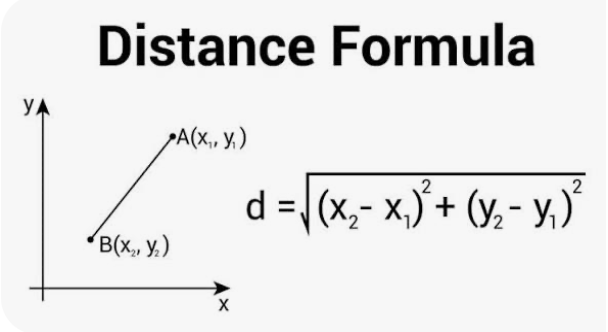
Many teachers will encourage students simply to memorize this string of coordinates, operations, and radicals. After all, it comes in handy across several years of math classes and college entrance exams (yes, it’s on both the SAT and ACT). It is a fish given to the student.
But now, consider students who are gifted with conceptual tools. They see that this formula is actually just a right triangle in disguise. Its legs and hypotenuse conform to everyone’s favorite rule: the Pythagorean Theorem (). When a student can SEE that the horizontal leg is and the vertical leg is , they can derive the distance formula themselves by plugging those expressions into the Pythagorean theorem.
No memorization required. They didn’t just receive a fish; they learned the mechanics of the pond. (Btw, we could play the same rote memorization vs conceptual understanding game with the Pythagorean theorem itself, but I will spare you a second example).
To be sure, a certain amount of rote memorization is a necessary foundation. You must memorize kitchen vocabulary before you can cook in French; you must memorize basic derivatives before you can master Calculus. But rote learning is only the bait. To reach the level where you can appreciate Candide or calculate the volume of a sphere revolved around an axis, you must move beyond memorization to conceptual understanding en route to mastery.
Perhaps we can take a lesson from the burgeoning field of experiential learning—where students gain skills through doing—and actually take our students fishing. Grab a subject, fill your tackle box with conceptual tools, and go catch some big fish!
We’re here to help :-).