
Back in 2008, I posted about an article from the FRONT PAGE of Wall Street Journal that terrified college-bound students and families from beginning to end, starting with its very title: “High School’s Worst Year? For Ambitious Teens, 11th Grade Becomes a Marathon of Tests, Stress and Sleepless Nights.” I’m not at all happy to report that the situation for juniors AND seniors hasn’t improved in the last nearly 18 years.
Perhaps the most frighting moment in the article came in the form of an audio recording of several minutes of an actual 11th-hour admissions committee meeting at a top college where final decisions were being made. At one pint an admissions officer asks for input on a highly qualified applicant who had made it to the 11th hour, a copy of whose file was open before each committee member. One replied—I’m paraphrasing—that something on the second page of the student’s main essay struck her as anti-intellectual. Suddenly, the recording captured the sounds of decision-makers’ rifling through papers, then silence as they read, until another officer said something like, I see what you mean and I agree. ‘Okay next applicant,’ came the reply from the committee chair (or something very like it), and so ended that student’s candidacy, the unfortunate culmination of what had clearly been four years of mindful and assiduous work and participation throughout high school.
I can imagine, had the applicant and not the reporter been present in that room, they might well have objected: ‘Wait! That’s not what I meant at all. I love learning and can cite verifiable excellent examples of my intellectual curiosity and exploration over four years.’ Sadly, though, that NEVER happens (see Tina Fey’s and Paul Rudd’s Hollywood Blockbuster movie, Admission, which wonderfully captures and parodies this sad truth, as well as the fact that officers generally cannot be bribed with bunt cakes 😂). All admissions committees know about you is what is contained in your application file, and most significantly, the words YOU USE to describe yourself and articulate your academic and personal goals for college. It is where the rubber meets the road in today’s ultra competitive college admissions games.
Therefore, with such high standards for so many admissions criteria in the 2020s before colleges will consider sending you an acceptance notification, IT IS PARAMOUNT TO GET YOUR WORDS RIGHT.
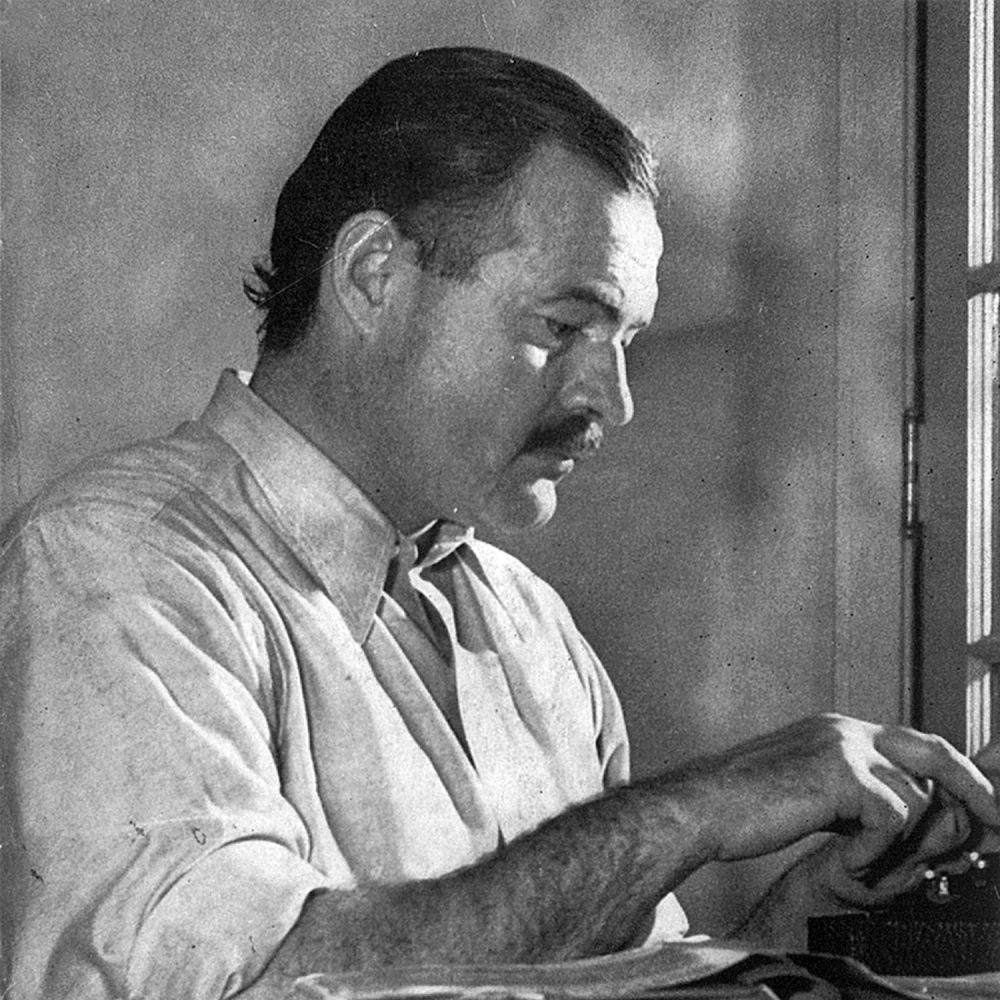
And that’s where Ernest Hemingway comes in, bringing some of the best advice you’ll ever hear about application writing (and writing in general) bar none, even though he was talking about his own work, not applications in particular (hey, it was easy to get in everywhere in 1917! And by easy I mean a 100% average acceptance rate across the board—dems were da days ;-)). Just in case you’ve never heard of Hemingway or were sick at the time or weren’t paying particularly good attention (please cut that out), Ernest Hemingway is widely considered one of the greatest wielders of the English language in the history of American literature. Many people consider his short stories and novels among their very favorite writing in the English language, and his works, The Sun Also Rises, A Farewell to Arms, For Whom the Bell Tolls, and The Old Man and the Sea are widely considered masterpieces.
Before I lay his simple yet profound implicit advice on you, I want to offer a word on the value of learning how to write well, including beyond applications. It is most important skill for college-bound students to acquire in high school (with few exceptions) and also arguably the most difficult. Not many students will disagree that translating ideas from their heads onto paper (or into pixels) proves extremely challenging. I love Gene Fowler’s quip: “Writing is easy. All you do is stare at a blank sheet of paper until drops of blood form on your forehead.” Fact: College professors’ #1 perennial complaint about freshmen is that they come to college without having really learned how to write.
So if you want to learn to write well, and at CollegePrepExpress we sure hope you do, the first thing to realize is that English class writing, whether analytical or creative (fun fact: ALL writing is creative!), history writing, science writing, etc., are all THE SAME: good writing is good writing, and the bottom line is that it COMMUNICATES. The litmus test? Are you translating the ideas in your head or feelings in your heart into words that do justice to those thoughts and feelings?
No doubt it is a difficult skill to develop, but far from impossible. It will take time, perhaps a lot of time—I know it did for me—both paying attention to what you consider really good writing as you read and paying careful attention to your own efforts to write. Most of that work is done on a second or third pass, as you edit and level up a rough draft. Hemingway suggests you go over the words on the page with a fine-tooth verbal comb. Whether your draft is one paragraph or 15 pages, the practice that develops writing skill is going over, sentence by sentence, line by line, word by word, what you see before you. You pass each clause, each phrase, and each individual word choice through a set of filters: Is this what I really mean? Is there a better way to express this? Am I being specific enough? Do my formulations make perfect sense only to me because I lived it and know what I mean, or will they communicate to almost anyone with a basic English reading ability? Bottom line: it’s all about getting the words right.
Hemingway’s implicit advice for college application writing comes in the form of a famous interview conducted in 1956:
Interviewer: How much rewriting do you do?
Hemingway: It depends. I rewrote the ending of A Farewell to Arms, the last page of it, 39 times before I was satisfied.
Interviewer: Was there some technical problem there? What was it that had stumped you?
Hemingway: Getting the words right.
(Ernest Hemingway, “The Art of Fiction,” The Paris Review Interview, 1956)
It can be very helpful to have a patient teacher, not necessarily by trade, who will sit with you and go through the process once or ten times. I am SO FORTUNATE to have a father (an English major, no less), who sat with me for HOURS AND HOURS when I was in 9th and 10th grades going over every sentence of the majority of English papers I handed in (mama dint raise no fool 😉). His perfectionism, while sometimes unnerving to an impatient teen, showed me the value in painstakingly reviewing and reworking what I had set down. On a wholly personal note, I’m sure I never said thank you nearly enough back then, feeling more a hostage than a willing student, but looking back now I see what a generous act of kindness and love it was on his part.
If you need assistance in learning how to write and neither of your parents were English majors, we’re here to help. Text or call Dr. Yo at (413) 329-7540, or check out our Application Review Services and our CommonApp Boot Camps 2026 (now open for early bird registration at 15% off), where helping you get your words right is our primary mission.
Oh, and one more thing: Thanks, Dad 🙂
P.S. If you had a special teacher or relative who helped you learned to write, why not share below in a Comment? You never know whom you might help or inspire.